 Reviews


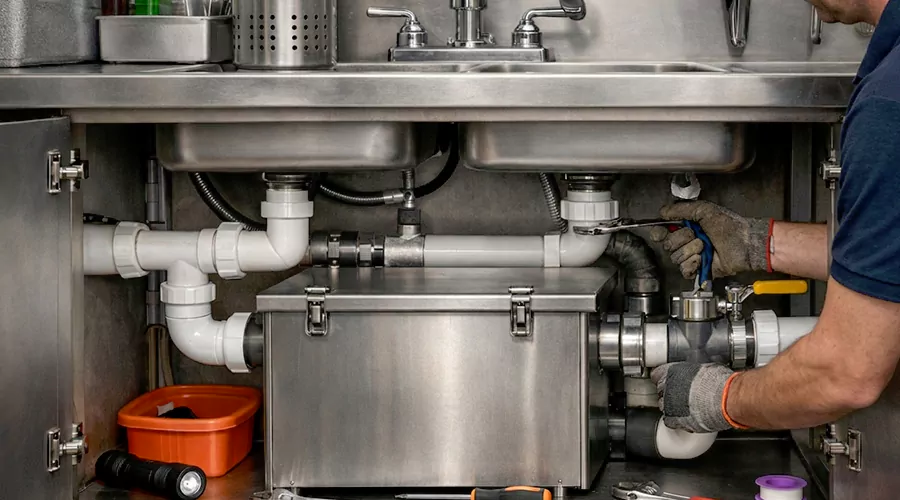
A grease trap is usually installed under or near the kitchen sink indoors, while large grease interceptors get buried outside the building. Traps run about 200 gallons or below under the sink and interceptors of 500 gallons and up sit buried outdoors.
Size picks the location every time. The unit either fits in a cabinet or needs an excavator.
Grease trap installation costs follow the same split, running from a few hundred dollars indoors to five figures in the parking lot. Here's every standard location and the rules that assign yours.
The Two Standard Locations
Two placements cover nearly every installation in America. Point-of-use units sit at the fixture they protect. Whole-facility tanks sit between the building and the sewer.
Industry names track the split. Hydromechanical units mount under the sink or in a floor vault and are rated at 20 to 50 gallons per minute of flow. Gravity interceptors are large concrete or fiberglass or polyethylene tanks installed outside or in the ground at 500 to 2,000 gallons.
The trade-off is service frequency against upfront cost. Indoor units cost less to install and demand cleaning as often as weekly. Buried tanks cost multiples more and go months between pump-outs.
Insider Tip: Your city's FOG control office assigns the category before you shop. The local office tells you which standard applies and what minimum size you need so call them first.
Under the Kitchen Sink
Under sink grease trap installation is the default for small and medium kitchens. The box mounts inside or beside the sink cabinet on the drain line. Delis and coffee shops and food trucks live in this category.
Speed is the location's gift. Grease trap under sink installation typically takes 2 to 4 hours and existing plumbing usually needs only minor rerouting. Access is the other advantage since the lid opens for cleaning without moving equipment during kitchen sink installation.
One routing rule governs the pipes. Kitchen grease trap installation connects only the grease-bearing drains, and no sewer waste should ever enter the trap. Toilets and floor drains bypass it entirely.
Insider Tip: Leave clearance above the lid equal to the trap's depth. A trap you can't open without disconnecting pipes becomes a trap nobody cleans.
Floor Vaults and Above Ground Rooms
Indoor placement scales past the cabinet in two ways. A floor-mounted grease trap sits in a shallow vault recessed into the slab near the fixtures. The lid finishes flush with the floor for wheeled-equipment kitchens.
Bigger indoor units claim mechanical space. A floor-mounted grease interceptor suits basements and utility rooms where the unit stands on the slab with piping entering high. Similarly, above-ground grease trap installation works wherever burial is impossible, which covers leased spaces and buildings over parking garages.
Material choice matters most indoors. High-density polyethylene resists corrosion completely, while metal traps often rot out within 7 years from the acidity of kitchen waste.
Outside and Underground
Underground grease trap installation serves high-volume kitchens through buried tanks between the building and the sewer lateral. The units approach the size of a small car and usually sit buried in the parking lot. Every drop of kitchen wastewater passes through before leaving the property.
The build is real construction. In-ground grease trap installation takes 1 to 3 days depending on soil conditions and tank size and crew size. Heavy materials need heavy equipment since concrete tanks require a crane while fiberglass tanks can sometimes be lowered with smaller equipment. That crane day is why grease tank installation quotes list equipment mobilization as its own line.
Outside grease trap installation also carries the forgotten line item. Parking lot repaving or sidewalk replacement or lawn restoration adds $1,500 to $5,000 after the hole closes. Budget accuracy improves once you know the interceptor itself is only 30 to 40% of the total with excavation and permits and site work driving the rest of any grease interceptor installation.
Insider Tip: Frost depth drives regional cost spread on buried tanks. Northern installs dig deeper for the same capacity so get local quotes rather than national averages.
Placement by Building Type
Building type predicts the location before any engineer calculates. Restaurant grease trap installation splits by volume with quick-service shops running indoor units and full-service kitchens feeding outdoor tanks. The menu decides more than the square footage.
Commercial rules scale up from there. Commercial grease trap installation in food courts and hotels and hospitals almost always means an outdoor interceptor because multiple kitchens share one sewer connection. Commercial kitchen grease trap installation inside those buildings sometimes adds point-of-use units at heavy fixtures as a second layer.
Homes sit mostly outside the conversation. Standard homes don't need one, though luxury estates with commercial-grade kitchens or homes on sensitive septic systems install small point-of-use traps. Residential grease trap installation therefore lands under the kitchen sink in the rare cases it happens at all.
The 3 Compartment Sink Rule
One fixture anchors indoor placement in most codes. Small trap boxes install directly under or near the 3-compartment sink because that sink produces the greasiest water in the kitchen. The trap catches the problem at its source.
Practical logic backs the code. A 3-compartment sink grease trap installation puts the shortest possible pipe run between the grease and the trap, so fats arrive warm and separate cleanly. Long runs let grease cool and coat the pipe before ever reaching the box.
Dishwashers complicate the rule. Many jurisdictions route high-temperature dishwasher discharge around the trap since near-boiling water pushes melted grease straight through. Your local code answers this one fixture at a time.
Code Rules That Decide the Spot
Four code requirements narrow the location before convenience gets a vote. Every jurisdiction enforces its own version. Check all four against any proposed spot.
- Accessibility for cleaning: The lid must open fully with working room around it.
- Position before the sewer connection: The unit sits downstream of kitchen fixtures and upstream of everything else.
- Venting per the plumbing code: Trapped systems need air like any drain.
- Inspection access: The installation must be inspected by the plumbing department and in many cities by the wastewater utility before service begins.
Standards name the equipment classes too, and tight kitchens have a third option since automatic grease removal devices skim FOG on a timed cycle where a large interceptor is not feasible.
What Installation Costs in 2026
Location writes the invoice in this trade. Indoor cabinet units cost dinner money while buried tanks cost renovation money. The table maps 2026 pricing by placement.
| Placement | 2026 installed cost |
|---|---|
| Basic under-sink unit | $400 to $1,300 total |
| Indoor hydromechanical unit | $800 to $2,500 with labor |
| Small indoor trap upper range | $2,000 to $5,000 |
| Outdoor in-ground interceptor | $7,000 to $15,000 and up |
| Large excavated commercial jobs | $10,000 to $30,000 or more |
Timeline follows the same split. An indoor unit swaps in 4 to 6 hours while a 1,000-gallon outdoor interceptor takes 5 to 10 business days including inspection waits.
Insider Tip: Get at least two quotes on any outdoor job. Excavation pricing varies more between contractors than the tank pricing ever does.
Other Names for the Same Box
Regional vocabulary renames the identical equipment. Knowing the synonyms keeps quotes comparable across suppliers. Two labels cover most of the variation.
Grease arrestor installation is the Australian phrasing on spec sheets and council permits. Fat trap installation is the common British label for the under-sink version. Meanwhile, some American contractors write grease trap interceptor installation on invoices, which blends both category names into one.
Ask about capacity and placement rather than terminology. A 40-gallon box and a 1,500-gallon tank are different projects no matter what either is called.
When to Call a Professional
Almost all of this work belongs with licensed plumbers from the first pipe cut. Grease equipment sits inside the drainage system where permits and inspections apply. Three factors make it non-negotiable.
- Dual inspections: The plumbing department and the wastewater utility both sign off in many cities.
- Sizing liability: An undersized interceptor leads to frequent pumping and premature failure and potential code violations, so sizing belongs with a licensed engineer on big jobs.
- Excavation risk: Buried utilities and soil conditions turn outdoor digs into specialist work.
The homeowner-scale exception stays narrow. Swapping a small under-sink unit onto existing legal rough-in is within skilled DIY reach where local code permits it.
Conclusion
Grease traps live under the sink and grease interceptors live under the parking lot, and volume decides which one your kitchen needs. Codes anchor indoor units near the 3-compartment sink while outdoor tanks guard the sewer connection. Nearly every install runs through permits and licensed hands. This week call your city's FOG office and ask which category and minimum size apply to your address. That free phone call is the first step of every version of this project.
FAQs
How far from the sink can an indoor trap sit?
As close as practical. Short runs deliver grease warm enough to separate while long runs coat the pipe first.
Can a grease trap go outside above ground?
Where climate and code allow, yes. Freeze-prone regions require burial below frost depth or heated enclosures.
Does a food truck need one?
Most jurisdictions require a small hydromechanical unit onboard or at the commissary. The under-sink class covers it.
Who owns the trap in a leased restaurant space?
The lease decides. Many landlords own buried interceptors while tenants own and maintain indoor units.
Can two restaurants share one interceptor?
Shared tanks serve food courts and strip malls routinely. The wastewater utility sizes and permits the shared unit.
How deep does an outdoor interceptor sit?
Deep enough for gravity flow from the building plus local frost requirements. Most lids finish flush with grade for pump-out access.